May 10-11
When I think of Hiroshima, I remember August 6, 1945, and what I learned from history lessons, documentaries, graphic images and movies. That event changed the city and the world, making Hiroshima and Nagasaki centers for promoting peace. When our ship docked, we saw the city’s resilience and couldn’t imagine the past destruction, as it is now modern with high-rises and a forward-looking stance. Our ship docked here overnight so we had enough time for a good visit.


Our first excursion took us to Peace Memorial Park which is near the hypocenter where a tremendous number of people perished. It was established to comfort the souls of the survivors of the atomic bombing, and as a reminder of the destructive effects of nuclear warfare.

As we strolled the park we stopped at the many monuments dedicated to the victims and commemorating the atomic bombing:


A-bomb Dome is the only skeletal ruin left preserved in its post-bomb state as a stark reminder
About 100′ from the park is a historical marker at the hypocenter, where the bomb exploded approximately 1,900′ above the ground:

Just a short walk from the park is the Hiroshima Peace Memorial Museum, which was crowded that day as many tour buses arrived:

Near the entrance is an image projection and a 3D model, click play to see depictions of the moments before, during and after the explosion, and the scale of the destruction:
Inside, everyone was silent and sombre while reading moving personal stories of the tragedy, seeing graphic images and looking at artifacts that showed the human impact of the destruction. Seeing these things stirred many emotions, and we learned much about that tragic day and the years that followed. While it was intense it was also an invaluable experience:


The east building displayed the technology and science of the atomic bomb, and explained and demonstrated the decisions made and the post-war context of why it should never happen again:

Both the Peace Memorial Park and Hiroshima Peace Memorial Museum are a must-visit in Hiroshima, despite the poignant vibe.
Today, Hiroshima is a city of peace and an advocate for world peace.

Beyond the memorials

Beyond its history as the first city ever to be destroyed by an atomic bomb, Hiroshima has been rebuilt into a vibrant place that holds much more than just memorials. We walked downtown on our own just to feel the vibe and look around. As with our other stops in Japan, the streets were clean, the people we met were polite and friendly, vending machines were all over the place and all public toilets had a bidet 🙂


Miyajima Island
Our second excursion was at Miyajima Island, famous for its sacred sites and scenic beauty. It is a place also known as the Island of Gods. To get here is just a 10-minute ferry ride from the city:

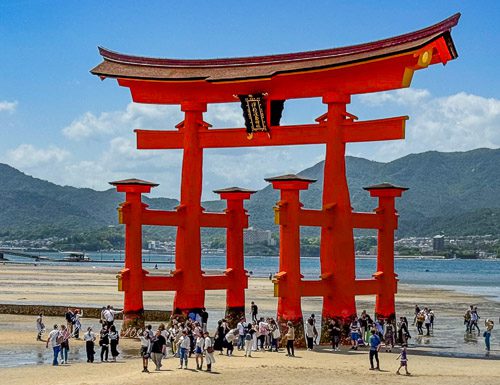
On the island is the Itsukushima Shrine, known for its Torii Gate – a shrine gateway which is part of a 1,400-year-old Shinto complex that’s listed as a UNESCO World Heritage site. Its striking appearance has made it one of the most recognizable attractions in Japan due to it seemingly floating in the ocean during high tides. We were here during a low tide and tourists were swarming the gate:


Our tour guide spoke very good English and shared with us her wedding picture at the Itsukushima Shrine with the Torii Gate in the background during high tide:

The Itsukushima Shrine is a Shinto Shrine that has a unique architecture, as the main shrine complex is built on stilts over the water connected by covered corridors. The current magnificent structure dates to 1168 when it was lavishly rebuilt by the powerful military leader Taira no Kiyomori. It was designated a UNESCO World Heritage Site in 1996 for its cultural and historical significance:

Our tour guide described the history and purpose of the shrine, and the function of each area:


A wedding ceremony was about to start during our tour:


Miyajima-cho within the Saeki District is the only town on Miyajima Island, home to 1,500 inhabitants. Heading back to the ferry terminal we passed stores and vendors where tourists could buy or simply look:


Back at the ship we did not get the same sendoff as we had at Nagasaki and Kagoshima, but there were still many friendly locals to bid us farewell from the dock:


Next up: More postcards from Japan
Comments
8 responses to “Postcards from Japan, Part 2 – Hiroshima”
Bidets in public toilets — my kind of place!! I’m all for decorative touches like the fancy sewer cover, but is that a picture of FOOD on it? eeeeeiiiick And now I’m curious about what makes one soy sauce different from another. Another great post, making me curious!
It looked like a pizza!
Thanks for the great tour. I’m glad you added the video of that sad day. Wow! You definitely had a nice visit. I know that table on the ship for dinner!!!!!
We did have a very good visit in Hiroshima.
I like the narrative of this travel. This place in Japan is in my bucket list.
Steve and Mona Lisa – We always enjoy your beautiful photos and narratives about your travels. We know we’ve not communicated for some time but we think of you often.
Don & Velma Trotter
Hi Don and Velma, glad to hear from you. And we are happy to know that you are following us.
Nice and educational. Maybe one day a visit to this place will happen